From Measuring the Listener to Hearing What They Intend to Hear
- Cristina Costa
- Jul 3
- 4 min read
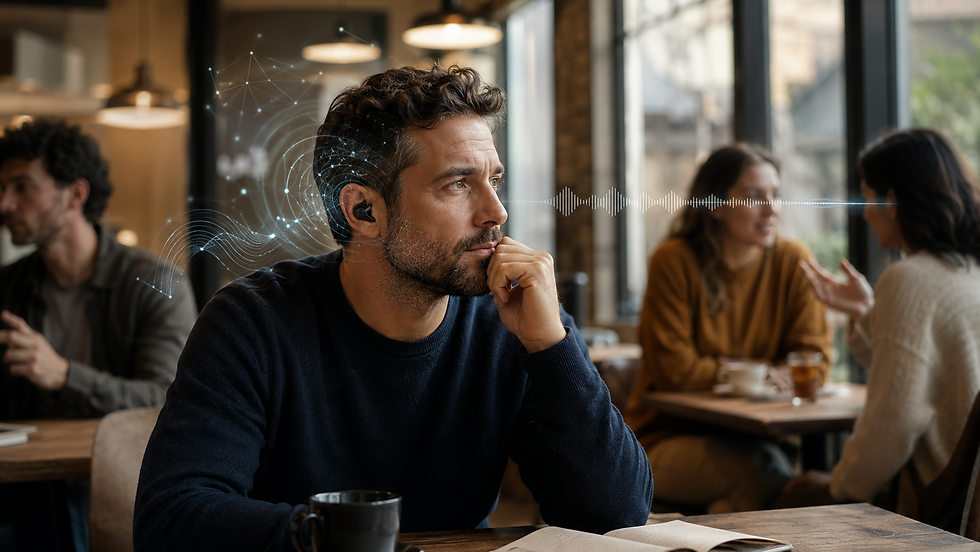
What if the next important audio measurement is not found in the loudspeaker, the microphone, or the frequency response—but in the listener?
Three papers presented at AES Europe 2026 approached that question from different parts of the human system. One examined whether nonlinear distortion in music playback is reflected in cardiovascular measures derived from photoplethysmography. Another combined frontal fNIRS with immersive reproduction of railway-cabin noise, exploring whether hemodynamic patterns could help identify states associated with increasing discomfort. A third compared self-reported headphone exposure with transient-evoked otoacoustic emissions, finding only weak associations and concluding that remembered listening habits may be too imprecise to detect subtle cochlear changes.
These studies do not measure the same thing. Heart-rate variability is not brain activity; fNIRS is an indirect measure of cortical hemodynamics; otoacoustic emissions primarily inform us about cochlear function. Nor do the papers establish a universal biological score for audio quality, comfort, or harm. Their common value lies elsewhere: they move the listener from the end of the test procedure into the measurement itself. Instead of relying only on the signal and on what a participant can describe, they ask whether experience leaves a measurable trace in the body.
A study published in Nature Neuroscience in May 2026 then changed the direction of that relationship. In four people undergoing intracranial monitoring for epilepsy, researchers used neural activity to determine which of two simultaneous conversations held the listener’s attention. That decoded focus controlled the relative gain of the speech streams in a real-time closed loop. When the system was active, speech intelligibility improved and participants preferred the assisted condition. Pupil measurements available from two participants were consistent with lower listening effort. A separate group of 40 people with hearing loss also preferred and benefited from the audio produced by the system, although their own neural signals did not control it.
The title therefore needs a precise reading. “What they intend to hear” does not mean that the system understood thoughts, motives, or meaning. It identified the conversation receiving auditory attention. The distinction matters. This was an invasive experiment using intracranial electrodes, the main closed-loop group contained only four people, and the system took an average of 5.1 seconds to follow an instructed change of attention. The 40 participants with hearing loss evaluated audio that had already been modulated from another user’s neural data. This is not a hearing aid ready for everyday life. It is a demonstration that, under controlled conditions, attention can become an active input to an audio system and produce a perceptual benefit.
That possibility becomes more interesting when placed beside developments reported by audioXpress. Attention Labs has presented an on-device system designed to separate and route relevant voices in multi-speaker scenes. It operates on acoustic and conversational data, not on the listener’s brain signals. In a different direction, IDUN Technologies and Analog Devices demonstrated an earbud platform intended to combine audio with in-ear EEG sensing. It was a prototype and technology platform, not the selective-hearing system described in Nature Neuroscience. Yet the two developments expose the engineering bridge ahead: one side must separate competing sounds quickly and reliably; the other must sense, without surgery and without becoming intrusive, which sound the person is trying to follow.
For decades, the listener was treated largely as the destination of the signal chain. These studies suggest a different architecture: the listener as part of a feedback loop. The signal changes the person; the person produces physiological and neural signals; those signals may eventually help the system change the sound. If that loop moves into practical products, accuracy will not be the only requirement. Latency, stability, environmental awareness, user control, consent, and the privacy of neural data will become audio-design questions too.
Perhaps the deeper change is not that machines may one day “read the mind.” That phrase promises too much and explains too little. The more useful possibility is quieter: audio systems that become better at recognizing what matters to the person using them. The next generation of assistive listening may not begin by asking only, “Which sound is loudest?” or even “Which voice is closest?” It may begin with a more human question:
What are you trying to hear?
Sources and further reading
Kenshin Nakada, Shun Muramatsu, and Takahiro Yoshida — “Influences of Nonlinear Distortion in Music Playback on Listeners’ Stress Evaluated by PPI & RMSSD of PPG”, AES 160th Convention, May 28, 2026.
Yonghee Lee, Yong Suk Oh, Wooseok Song, and Jiyoung Hong — “Comfortability Analysis of Immersive Sound Playback System for Cabin Noise Based on Frontal Lobe fNIRS Experiment: An Application of 4th Order Ambisonics”, AES 160th Convention, May 28, 2026.
Rodrigo Ordoñez and Dorte Hammershøi — “Transient Evoked Otoacoustic Emissions and Self Reported Sound Exposure”, AES 160th Convention, May 28, 2026.
Vishal Choudhari et al. — “Real-time brain-controlled selective hearing enhances speech perception in multi-talker environments”, Nature Neuroscience, May 11, 2026.
audioXpress — “Attention Labs Announces Selective Auditory Attention Technology to Differentiate Between Multiple Concurrent Voices”, August 6, 2025.
audioXpress — “IDUN Technologies and Analog Devices Join Efforts to Unveil Brain-Sensing Earbuds at CES 2025”, January 2, 2025.


