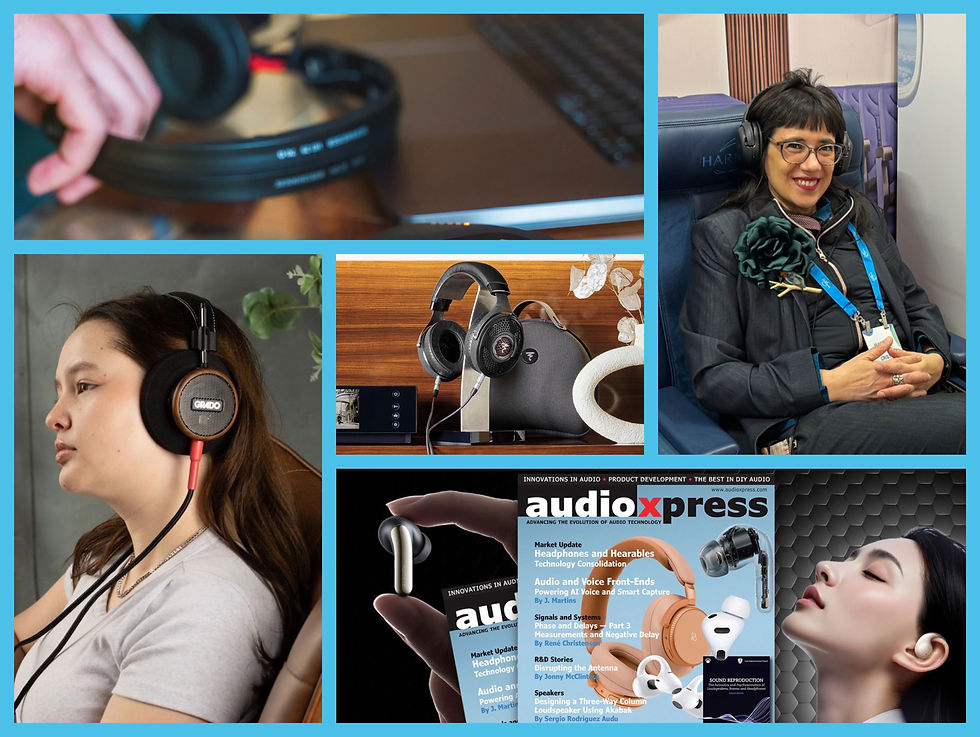
Almost always accompanied by music or a podcast

I have several places where I listen, and I don’t listen the same way in any of them. That small reflection on my own habits is what made me pay particular attention to the panel “Listening Is Back — But No Longer Only in the Living Room,” held at IFA 2026 in Berlin.
The premise was simple: for decades, we associated the best listening experience with the living room. Today, that experience is spread across headphones, the car, the soundbar, the office, and the different moments of the day. In the car, on my way to work or back home, if I’m alone, I almost always tune in to Antena 2. I enjoy classical music, but I also value what a public radio station like this represents: music, arts, science, jazz, and other areas of culture. If someone is with me, the choice changes. I look for other stations that still offer thoughtful music curation but work better in that shared space.
The office brings another shift. Some days, the noise of an open-plan workspace becomes too present and, if I’m tired or stressed, I put on classical music through streaming. It isn’t only about listening to music. It is a way of creating a different atmosphere within the same room, almost as if I were drawing a sound boundary between myself and everything happening around me. On other days, I don’t need that distance, and that’s when my own playlist comes in — difficult to classify because it crosses decades, genres, and styles without much concern for boundaries. And when I’m doing more mechanical tasks that don’t require my full attention for writing or reasoning, I often trade music for science or history podcasts connected to current events.
At home, the logic changes again. Music is almost always playing and, in that sense, perhaps we really do have an “extended living room” that reaches into every room of the house: sound is no longer tied to the place where the audio system would traditionally be. It moves with us through the home.
The IFA panel made me think about audio personalization in a slightly different way. João Martins spoke about the importance of a personal listening profile that can follow the user across headphones, the car, a soundbar, and other systems. Technologically, that makes perfect sense. But perhaps our real “listening profile” is even more complex. It isn’t only a collection of music preferences or acoustic parameters. It is also context: Where am I? Am I alone or with someone? Do I need focus or company? Do I want to reduce the world around me or remain more open to it? Do I want to listen to music, or learn something while doing another task?
The Freizeit-Monitor 2026 offers an interesting data point for this discussion: in Germany, the percentage of people who say they listen to music at least once a week rose from 52% in 2016 to 82% in 2026. Over the same period, weekly radio use fell from 90% to 70%, while reading newspapers and magazines dropped from 72% to 36%.
That does not necessarily mean that one way of listening has simply replaced another. Perhaps it means that audio has learned to fit into more moments of our lives. And that changes something important: for a long time, we designed audio systems for spaces. Increasingly, we are designing audio experiences for people moving between spaces, devices, tasks, and different states of attention.
The next stage of personalization may therefore be about more than recognizing who is listening. It may be about understanding how we want to listen in that particular moment.
Sources and further reading