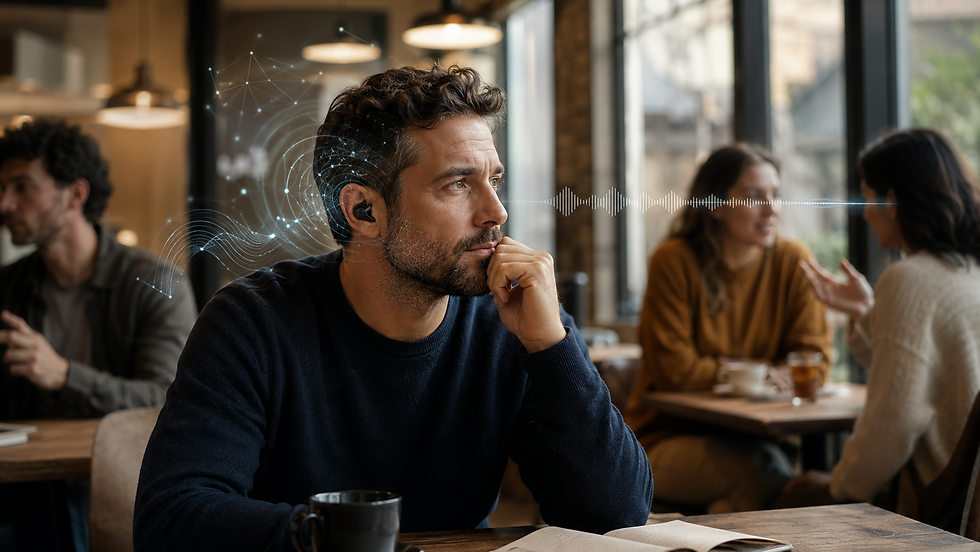
Your earbud can already read your brain. Your work interface has no idea. That's about to change — faster than you think.
- Cristina Costa
- May 8
- 2 min read
In February 2026, Naqi Logix acquired Wisear to turn everyday earbuds into neural interfaces that detect brainwaves, muscle impulses, and facial micro-gestures — no touch, no voice, no screen.
Not sci-fi. audioXpress, January 2025: IDUN Technologies and Analog Devices debuted EEG-integrated earbuds at CES 2025 to monitor sleep, focus, and cognitive load in real time.
But here's the question nobody is asking:
What if the problem isn't the device — but the fact that AI still can't tell what's happening inside your head?
That's the problem NAFAS is solving.
$30 million euros. 4 years. The largest single research project currently funded in the EU.
Led by Zander Labs, NAFAS wants autonomous systems to learn directly from the human brain — not through commands, but by reading cognitive load in real time via EEG.
Here's what Nautilus tells us about how this actually works:
Your brain doesn't react to the world — it predicts it.
Before you see a cat, your brain has already sent a "cat hypothesis" to your eyes.
When the prediction fails, your brain burns more energy to recalibrate — what Kahneman called "thinking slow."
That exact moment — the prediction error — is what NAFAS wants to capture and transmit to machines.
Fraunhofer IDMT (Oldenburg, Germany) was critical to the project's first phase:
• Built the trEEGrids — patented electrode patches that stick discreetly to the face
• Optimized placement, materials, and design for maximum signal quality — no gel, no lab setup
• Extended electrodes to the top of the head to improve signal-to-noise ratio
The result: high-quality EEG, self-applied, outside the lab.
Nautilus research shows why this is so hard to pull off:
When you mentally recall an image, 40% of the neurons you used to see it reactivate with the exact same pattern.
Capturing those patterns reliably — on a street, in an office, on a factory floor — is the gap the trEEGrids are closing.
And there's a dimension that rarely gets discussed:
The quality of brain signals depends on a rested brain.
Nautilus recently covered the glymphatic system — the mechanism by which the brain "cleans itself" during sleep, flushing metabolic waste through cerebrospinal fluid pulsations.
Slow vasomotor waves below 0.1 Hz directly influence the brain's electrical activity overnight.
That's exactly why the Oldenburg team also runs SleepWell — mobile EEG applied to sleep disorder diagnosis and therapy.
NAFAS is set to wrap up in November 2027.
The question isn't whether machines will learn to read the human brain.
The question is: will your organization be ready when they do?
Sources: audioXpress — Cristina Costa, "Fraunhofer IDMT and Zander Labs Develop EEG System for Brain Interfaces," May 7, 2026 · audioXpress — Joao Martins, "Neural Interface Earbuds: Naqi Logix Closes Acquisition of Wisear," February 2026 · Nautilus — "The Biological Basis of Imagination" · Nautilus — "How Does Your Brain Know a Cat Is a Cat?" · Nautilus — "How Sleep Cleans the Brain" · Fraunhofer IDMT-HSA, Oldenburg · Zander Labs / Cyberagentur
https://audioxpress.com/news/fraunhofer-idmt-and-zander-labs-develop-eeg-system-for-brain-interfaces